FAQs for Providers
Q: How will I know which of my patients are affected?
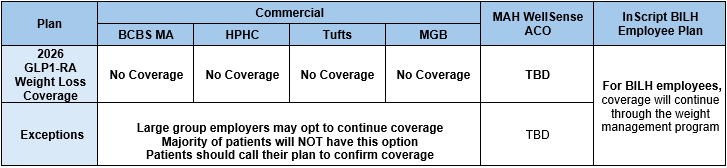
A: Health insurance providers will send out letters to patients informing affected individuals at least 60 days in advance. Expect patients to receive letters beginning in November. BILHPN may receive patient impact lists from some payers – if you would like to receive your patient list - reach out to your pharmacist or BILHPNPharmacyProgram@bilh.org
Q: Will insurance providers cover Zepbound for obstructive sleep apnea (OSA) or Wegovy for cardiovascular risk reduction in obesity?
A: Some payers have announced that there will be no exceptions for coverage of weight loss GLP-1RAs, regardless of indication. Patients should call their individual plan for coverage information. If plans provide coverage for GLP-1RAs for weight-related indications—such as OSA or cardiovascular risk reduction in obesity—they will likely require prior authorization.
Q: Should I start my patient on a GLP-1-based medication for weight management now while it is still covered?
A: It is not recommended to initiate a GLP-1-based medication for weight management based on current coverage, as many insurance providers will likely be removing certain weight loss medications from their formularies effective January 1, 2026. In 2026, prescribers should direct patients to verify individual coverage by calling their insurance plan before starting treatment for weight management.
Q: Will other medications for weight loss be covered?
A: Some payers have removed all medications indicated for weight loss from their formularies (i.e Contrave®, Qsymia®). Patients should be directed to contact their plans to inquire about coverage for non-GLP-1RA medications for weight loss.
Q: Will my patients taking Mounjaro, Ozempic, Trulicity or Victoza for diabetes be affected by this?
A: No.GLP-1-based medications approved for diabetes management are not affected by these changes. The coverage changes apply specifically to weight loss coverage and are not expected to affect diabetes treatment. Plans will likely continue to require prior authorizations for GLP-1-based medications for diabetes management.