Beyond Prescriptions – BILHPN Pharmacy Program Updates |
|
|
|
Considerations When Discontinuing a GLP-1 Agonist |
Starting January 1, 2026, several major health insurance providers will implement significant changes to their formularies regarding weight loss medications. These changes will greatly reduce access to GLP-1RAs indicated for weight loss, such as Wegovy®, Zepbound®, and Saxenda®. In the remaining months of 2025, it is important to have a discussion with affected patients regarding what to expect when discontinuing GLP-1RAs, strategies to help them meet their weight loss goals, and potential alternative therapies.
Discontinuation of GLP-1RA: -
Once discontinued, the changes to a patient’s incretin pathway and appetite will begin to return to baseline.
- Tapering off of a GLP-1RA is
not required prior to discontinuation.
- Lowering the dose or
decreasing the administration frequency may make the transition off of a GLP-1RA easier for patients.
Weight regain: -
Weight regain is very common after GLP-1RA discontinuation.
- Not all patients will return to their baseline weight.
-
An extension of the STEP 1 trial observed that patients who used semaglutide for the 68-week trial regained approximately two-thirds of what they had lost within 1 year of discontinuation.1
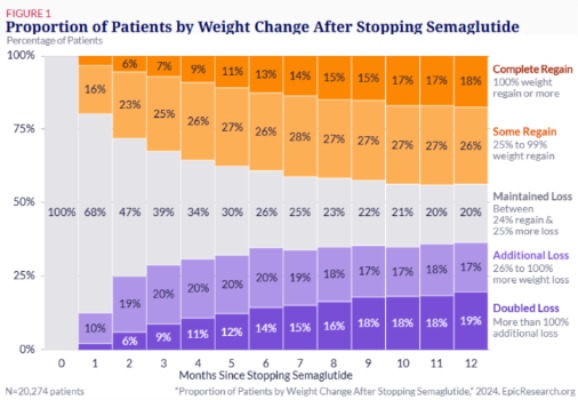
- Another observational study noted that after 1 year of discontinuing semaglutide, 18% regained all the weight they had lost, 26% regained 25 to 99% of their baseline weight, 20% maintained their weight loss, and 36% continued to lose weight (see Figure 1).2
-
In both studies, concomitant weight loss therapies were not encouraged or tracked.
|
-
A study investigated the sustainability of weight loss results of patients who took a GLP-1RA with an established exercise plan and those who took a GLP-1RA alone. They observed that one year after discontinuing therapy, patients who utilized a GLP-1RA plus an established exercise plan experienced significantly less weight regain, than those who were taking a GLP-1RA alone.3
- It is equally important to establish and reinforce positive dietary habits
prior to GLP-1RA discontinuation. After discontinuation, the patient’s appetite will begin to revert to how it was prior to initiation, making it more difficult to implement these changes.
- Consider referring your patient to a dietician or nutritionist if you anticipate they will struggle with dietary adjustments.
Alternative Options - Oral Weight Loss Medication
- Surgical Options
- Can be considered for patients with a BMI >35 or >30 with another condition related to obesity (ex. diabetes or hypertension).
- Patients can lose up to 60% of excess weight within 6 months and up to 77% within 12 months.4
-
Low-risk procedure with an estimated mortality rate of ~0.04%.5
- Self-Pay Option: A new prescription must be sent to the program pharmacy
- Patients can continue GLP-1 therapy out of pocket (~$500/month) through:
- Manufacturer programs:
-
Pharmacy programs (e.g., Costco for Wegovy® pen)
- Patients with Type 2 Diabetes
- Patients with Type 2 Diabetes currently taking Zepbound®, Wegovy®, or Saxenda
® should transition to the GLP-1RAs indicated for diabetes, such as Trulicity®, Ozempic®, or Mounjaro
®.
- These frequently require a prior authorization (PA) containing the diagnosis, A1c, and other medications tried for diabetes, both past and present.
-
Please see the BILHPN GLP-1 Agent Conversion Chart and Therapy Gap Management Guide with questions regarding GLP-1RA conversions.
Reviewed by: Alexa M Triot, MD
Assistant Medical Director, Healthcare Associates
Clinical Director of HCA Embedded Primary Care Weight Management Programs
Division of General Medicine and Primary Care
Beth Israel Deaconess Medical Center References: -
Wilding JPH, Batterham RL, Davies M, et al. Weight regain and cardiometabolic effects after withdrawal of semaglutide: the STEP 1 trial extension. Diabetes Obes Metab.2022 Aug;24(8):1553-1564
-
Bartelt K, Mast C, Deckert J, Gracianette M, Joyce B. Many Patients Maintain Weight Loss a Year After Stopping Semaglutide and Liraglutide. Epic Research. https://epicresearch.org/articles/many-patients-maintain-weight-loss-a-year-after-stopping-semaglutide-and-liraglutide. Accessed on October 13, 2025.
- Jensen SBK, Blond MB, Sandsdal RM, et al. Healthy weight loss maintenance with exercise, GLP-1 receptor agonist, or both combined followed by one year without treatment: a post-treatment analysis of a randomised placebo-controlled trial. EClinicalMedicine. 2024;69:102475.
-
American Society for Metabolic & Bariatric Surgery. Metabolic and Bariatric Surgery. Accessed October 20, 2025. https://asmbs.org/resources/metabolic-and-bariatric-surgery/
-
Lim RB. Bariatric procedures for the management of severe obesity. UpToDate. UpToDate; 2025. Accessed October 20, 2025. https://www.uptodate.com/contents/bariatric-procedures-for-the-management-of-severe-obesity-descriptions
|
|
|
|